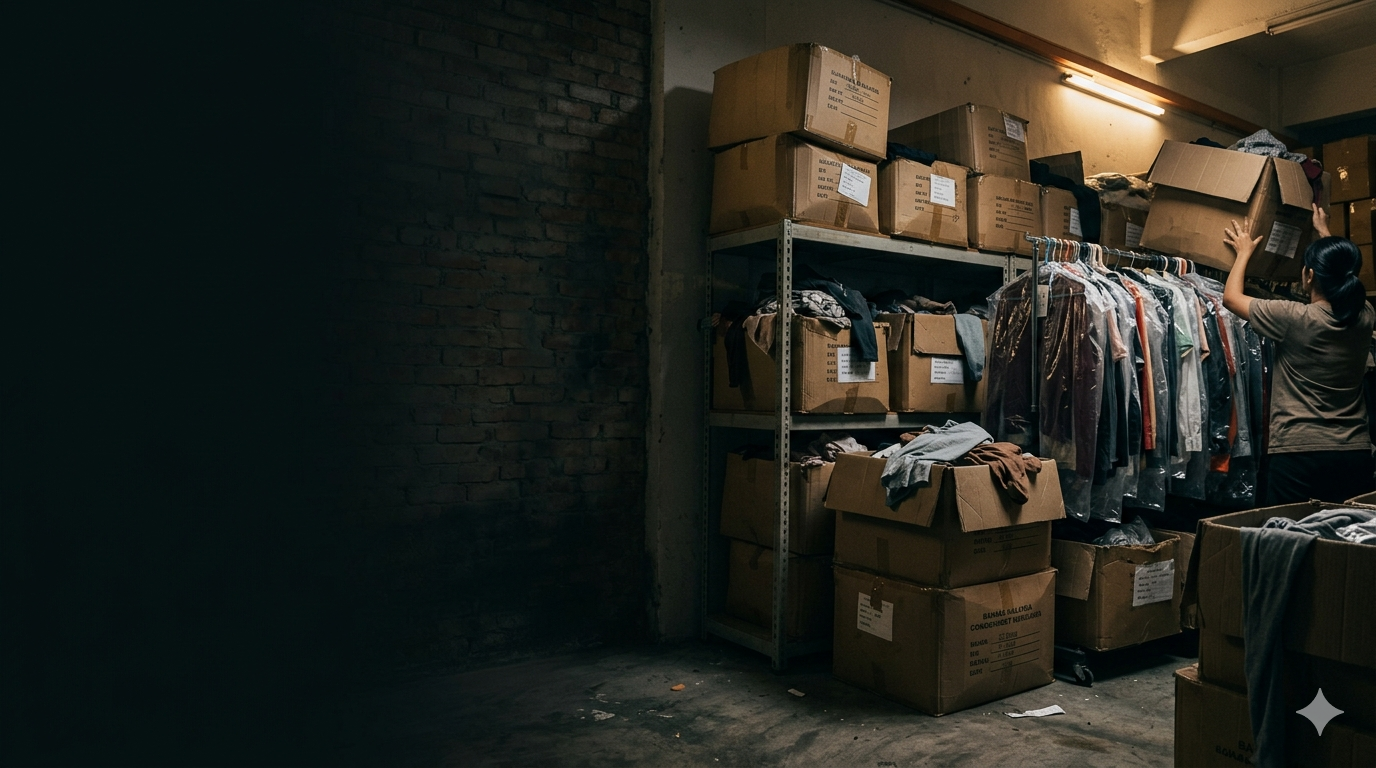
Stock leaves your warehouse — and visibility stops there.
Consignment puts your goods in front of more customers — but the moment they leave your warehouse, visibility drops. Statements come in late, stock figures don't add up, and your consignees are always one step behind. There's a reason for that — and a system that fixes it.
Stock leaves your warehouse — and visibility stops there.
Consignment isn't one model — it's three. Each one comes with its own operational complexity. All of them share the same two breaking points.
You supply your goods to department stores, men's stores, or specialty retailers on a consignment basis. You own the stock until it sells. Your problem: the retailer controls the counter, the reporting, and the timeline — and you're always the last to know what's actually happening.
You operate retail locations under your own brand label but hire consignees — effectively business owners — to run the daily operations. You set the standards. They execute. The gap between those two things is where your margin disappears.
You produce the goods. A brand owner manages the marketing and sales, taking a cut from every sale. You transferred the risk — but you still carry the inventory until it moves. Without visibility into the sales pipeline, you're flying blind on production planning and cash flow.
Regardless of which model you operate, the two problems that surface every time are the same: you don't know where your stock is, and you're waiting too long for accurate numbers. Everything else flows from there.
Sound familiar? Let's spend 30 minutes looking at your operation.
Free 30-Minute Call · No pitch, no pressure
Consignment is easy to start. The complexity arrives quietly — and accelerates the moment you scale beyond what manual tracking can handle.
Delivery orders tell you where goods went. They don't tell you where they are now — what sold, what was returned, what's missing. Below 10 outlets, manual DOs are manageable. Above that, you're reconciling guesses against guesses.
At 10 locations, closing takes a few days. At 30 locations across different consignees, the same process stretches to weeks — and by the time the numbers are ready, the month after has already started. Nobody acts on old data.
Late statements, incomplete sales reports, figures that don't reconcile with your records. Every delayed report delays your invoice, delays your payment, and delays your production or replenishment decisions.
Without defined roles on both sides, stock discrepancies fall into a grey zone. Who raised the DO? Who received it? Who counted it? When nobody is accountable, disputes become the norm rather than the exception.
The manual processes, the WhatsApp updates, the spreadsheets — they feel manageable until they don't. And by the time you realise the system has broken, you're already six months into the problem.
Software doesn't replace a system — it amplifies whatever system you already have. If your processes are broken, your ERP will break faster and cost more. You fix the process first. Then you automate it.
The consignors who scale without losing control aren't the ones who work harder — they're the ones who built the system before the chaos arrived.
These aren't minor inefficiencies. Each one is a signal that your consignment operation is running ahead of your ability to control it.
You wait weeks for statements that should come in days. By the time you have the numbers, you've already missed the window to restock, replenish, or pull slow-moving goods.
Your system says 200 units at a location. The physical count says 173. Nobody can explain the difference — and every month the gap seems to grow wider.
You know what you shipped out. You don't know what's moved, what's sitting, and what needs to be pulled. Every decision is based on last month's data at best.
You can't invoice until the closing is confirmed. Closing isn't confirmed because the consignee hasn't submitted. Your cash flow suffers because someone else controls your timeline.
The consignee points at the DO. You point at the receiving record. There's no clear audit trail and no defined accountability — so every dispute becomes a relationship negotiation.
Every new counter is another stock pool to track, another consignee to chase, another reconciliation cycle to manage manually. Growth is creating more problems than it's solving.
Any of these sound like your operation? The Ops Check is where we start.
Free 30-Minute Call · No pitch, no pressure
In 2006, I became one of the first consignees to open a retail outlet in Queensbay Mall, Penang — operating under a major international footwear brand as a consignee. Over the next decade, I grew that operation across multiple Northern region locations, scaling from an initial turnover of around RM500K to over RM5 million annually.
I was good at running the system. But I was building someone else's brand, on someone else's terms. When the brand decided to take back their retail operations and run them directly — no longer extending consignee arrangements — I was left with something more valuable than the business itself: a precise understanding of how consignment operations work from both sides of the counter.
That became the turning point. I stopped being the consignee executing someone else's playbook. I started building the frameworks that help brand owners and consignors run their own — so you become the one setting the terms, not the one waiting on them.
Since then I've worked inside consignment operations at scale — systematising a major multi-brand consignment network that had over 150 active counters when I joined, where reconciliation was taking months to close. Today that same operation closes within two weeks, stock accuracy is above 98%, and the network has grown to over 300 counters — and still expanding.
Whether you work with us through a workshop, consulting, or full implementation — these are the operational pillars we build around your business.
The foundation. If you don't know where your stock is, nothing else can be fixed.
Closing should confirm what you already know — not be the first time you find out what happened.
You control your cash flow when you control the invoicing timeline — not the other way around.
Everybody doing everything means nobody is responsible for anything. Clear roles fix this.
Software amplifies what's underneath it — good or broken. We fix the process before you invest in the tool.
Most brand owners use consignment to get their goods into more locations. The ones who scale significantly use it to build something larger — a structured network with leverage they control.
Instead of supplying goods to retailers on their terms, build a consignee network on yours. Define the standards, control the reporting, set the accountability framework. You become the franchisor — not the one executing someone else's playbook.
The consignee-as-franchisee model means your brand expands without your headcount growing at the same pace. You're effectively hiring entrepreneurs to operate under your system — but only if you have a system worth operating under.
If you manage the brand and the marketing, manufacturers can supply the goods on a consignment basis — transferring inventory risk while you manage the sales channel. The right structure makes this work for both sides. The wrong one creates a cash flow crisis for the manufacturer and a quality problem for you.
All three models require the same foundation: stock visibility, clean reconciliation, and defined accountability. Build that first — and the growth options open up naturally.
After the Free Ops Check, we recommend the right level of engagement — not the most expensive one.
Practical articles on consignment operations, stock visibility, reconciliation, and what actually breaks at scale. No fluff — written from inside the industry.
A structured programme covering all five operational domains. You get the frameworks, templates, SOPs, and a 90-day roadmap. You and your team implement.
We work through the implementation together. You make the decisions. We provide the structure, challenge your thinking, and keep the project on track.
We assess the operation, design the systems, and implement alongside your people. You focus on running the business while we build the infrastructure underneath it.
All engagements start with a Free Ops Check — so we understand your operation before recommending anything.
Three ways to engage with the ConsignmentOps framework — from reading to doing to getting assessed.
The complete framework for running a consignment operation that scales. From stock visibility to reconciliation — written from inside the industry.
Read the PlaybookTemplates, SOPs, and checklists — ready to implement from day one. The operational infrastructure your consignment business needs to run clean.
Get the KitAnswer five questions. Get an instant read on where your consignment operation stands — and what to fix first.
Run the Fit CheckNo pitch. No pressure. Just a clear-eyed look at your operation and what to fix first.
Free 30-Minute Call · No pitch, no pressure